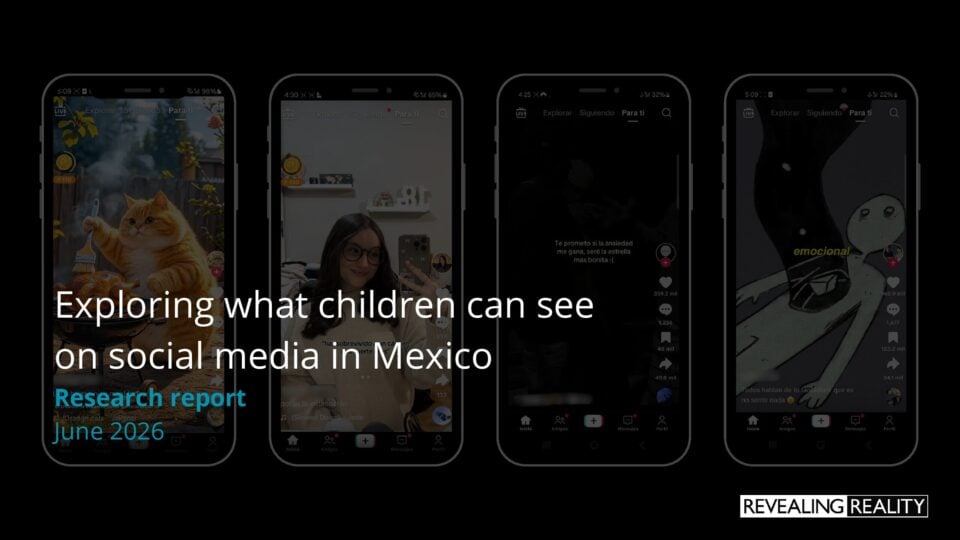

Exploring what children can see on social media in Mexico
*CONTENT WARNING: This report and accompanying case study videos contain references to self-harm, suicide, sexual content, eating disorders, and graphic violence.
Social media platforms, including TikTok, Instagram, and X, state that they are committed to keeping children safe online.
Published by 5Rights Foundation, Revealing Reality, and the National Institute of Public Health of Mexico, with the support of El hilo de Ariadne, this new research sets out to explore how these commitments translate into real experiences for children in Mexico. Using simulated social media profiles – avatars – based on real children’s online behaviours, the research examined what content could be surfaced through everyday actions such as scrolling, liking, following, and searching.
Key findings
- All the avatars were able to access all platforms easily, without encountering meaningful age verification measures.
- In some cases, avatars were shown potentially harmful content – including material related to self-harm, cartel violence, and sexualised imagery – within a relatively short period of engagement.
- Search functions appeared to play a key role in enabling access to specific types of content, even where some terms were blocked or triggered warnings.
- On TikTok, a small number of avatars were also shown coin-based features that appeared to reward extended viewing, although the purpose and impact of these features were unclear.
Case study on sexual content – Javier (15)
Case study on mental health content – Helena (15)
Case study on violent content – Gabriel (14)